Garage door blog · Tuscaloosa, AL
Keeping rust off garage door hardware through a humid Tuscaloosa summer
Orange streaks on the bottom brackets, or a cable that looks rough near the floor? Humid air and wet driveways work on garage door steel all year. Here is where rust starts, what a homeowner can safely do about it, and which rusty parts need a professional.
- Answered 24/7
- Tuscaloosa and West Alabama
- Rust prevention that works
By Lloyd Yeager, Garage Door Blog EditorUpdated October 2026
Rust on a Tuscaloosa garage door starts low, where the bottom brackets, lift cables and lower rollers sit in damp air near a wet floor. A light coat of garage door lubricant on the springs, hinges and roller bearings twice a year, plus a working bottom seal, slows it down. Rusted cables and bottom brackets are a job for a technician.
Why Tuscaloosa garages are hard on steel hardware
Moisture is the whole story. Tuscaloosa averages 53.52 inches of precipitation a year over 117.7 precipitation days, with February the wettest month, according to Wikipedia. Then summer adds the humidity: WeatherSpark puts the muggy season at roughly May 25 to September 22, with July averaging 17.3 muggy days.
A closed garage traps that damp air. Cars bring in rainwater on the tires and underside, the concrete slab stays cool and collects condensation, and the bottom few feet of the door sit in the wettest air in the room. Steel that would last decades in a dry climate starts to surface-rust within a few seasons when it never quite dries out.
Where rust shows up first on a garage door
Work your way up from the floor. These parts rust in roughly this order, and the first two matter most for safety:
- Bottom brackets. They anchor the lift cables at the lower corners of the door and sit right at floor level. Rust here can weaken the bracket where the cable pulls hardest.
- Lift cables. The lowest few inches, where the cable loops onto the bracket, stay wettest. Look for orange staining, broken strands or a cable that looks thinner there.
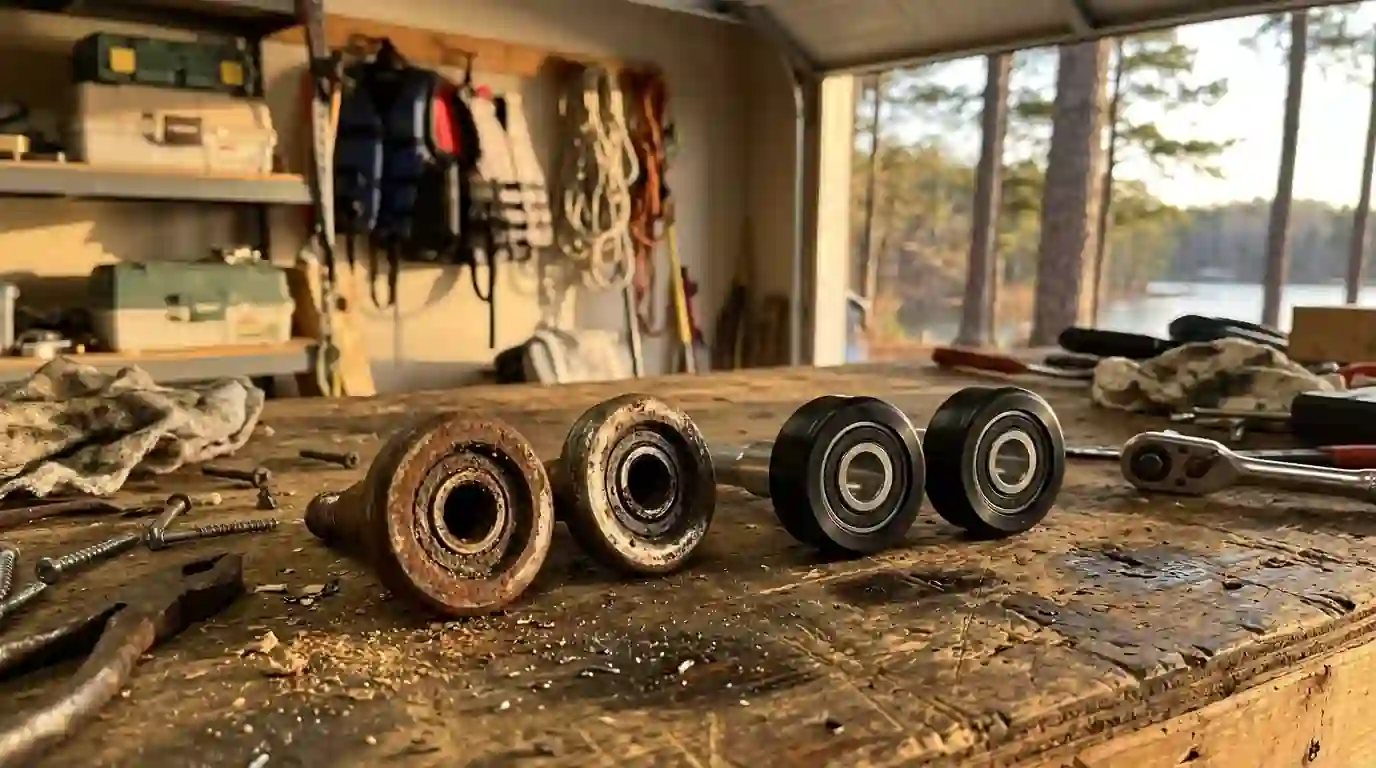
- Lower rollers and hinges. Steel roller bearings seize when rust gets in, and a seized roller drags in the track instead of turning.
- Torsion springs. Surface rust adds friction between the coils and can shorten spring life.
- Track bolts and the bottom of the track. Usually cosmetic, but worth watching where the track meets the floor.

What you can safely do: cleaning and lubrication
A twice-yearly routine does most of the work. Once in spring before the muggy season, and once in late fall, is easy to remember.
- Close the door and unplug the opener.
- Wipe the hardware. Use a dry rag on the hinges, rollers and the lower track to remove grit and old grease.
- Lubricate the moving parts. Use a garage door lubricant or a light silicone or lithium spray on the hinge pivots and roller bearings, and wipe off the excess. For the torsion springs, spray a light mist from a stepladder without touching the spring, cones or shaft.
- Leave the tracks dry. Rollers should roll, not slide; grease in the track collects dirt.
- Plug the opener in and run the door a few times to spread the lubricant.
What not to do: do not use a penetrating degreaser as your only lubricant, since it strips grease and leaves the part dry once it evaporates. Do not grease nylon rollers with sealed bearings. Never try to wire-brush, sand or loosen a torsion spring, a lift cable or a bottom bracket. Those parts are under tension whenever the door is closed, and the bottom bracket bolts hold that tension in place.
Seeing rust on the cables or bottom brackets? Leave them alone and call; the phone is answered 24/7.
Call (205) 679-9076Rusted parts that need a technician, not a spray can
Lubricant slows rust; it does not undo it. Once a load-bearing part is rusted through or pitted, the fix is replacement. Call when you see any of these:
- A lift cable with broken strands, kinks or heavy rust where it meets the bottom bracket.
- A bottom bracket that is flaking, swollen with rust or pulling away from the door.
- Rollers that have stopped turning and skid along the track.
- A torsion spring coated in heavy rust, especially one that has been squealing.
Published ranges help with planning. HomeGuide puts lift cable repair or replacement at $150 to $350, and Angi gives $110 to $230 for roller replacement, parts and labor. Our frayed cable repair page explains why both cables are usually done together, and roller replacement covers nylon rollers with sealed bearings, which hold up far better in a damp garage than bare steel.
Seals and drainage: keeping water off the hardware
The bottom seal is the first line of defense. A cracked, flattened or torn seal lets rain run under the door and pool against the bottom brackets and the foot of the tracks. Where the driveway slopes toward the garage, a threshold seal on the floor adds a second barrier.
Replacing worn seals is one of the cheaper ways to protect the steel behind them. HomeAdvisor puts complete garage door weatherstripping replacement at $200 to $600, and Fixr gives $100 to $200 to add or replace weatherstripping on an existing door. Our weather seal replacement page covers the seal types. Inside, sweeping out standing water after a storm and opening the door on dry afternoons both help the garage dry out.
Lake homes and garages close to the water
Homes near Lake Tuscaloosa face more of the same. The lake covers 5,885 acres and was completed in 1970 by damming the North River, according to the City of Tuscaloosa, and garages close to that much open water sit in damper air for more of the year. Boats and trailers parked inside bring in extra moisture too.
In those garages, plan on the twice-yearly lubrication without fail, check the cables at the bottom brackets at the same time, and consider galvanized or coated springs and nylon rollers when parts are replaced. A dehumidifier or a vent fan in a closed lake-house garage protects the door, the opener and anything else stored there.
Let a tune-up catch rust early
Most rusted parts give plenty of warning, which is why an annual check pays for itself. HomeGuide puts a garage door tune-up at $100 to $250, covering inspection, adjustment, lubrication and safety checks. A tune-up is a good moment to have the cables, brackets and springs looked at closely by someone who can safely handle them. If cold mornings are also hard on your door, our guide to a snapped torsion spring explains why tired springs tend to fail then.
Common questions
More questions on this
Light surface rust is common and not urgent, but it adds friction and wear. Heavy rust, pitting or squealing coils mean the spring is due for a professional look.
A garage door lubricant or a light silicone or lithium spray. Apply it to hinges and roller bearings, mist the springs without touching them, and leave the tracks clean and dry.
They sit at floor level beside the bottom seal, where rainwater and condensation collect. They also anchor the lift cables, so rust there matters more than elsewhere.
On the door face, yes: sand the rust, prime and paint. Do not paint springs, cables or brackets, and never sand parts that are under spring tension.
In a closed garage near the lake or one that floods often, yes. Drier air slows rust on the springs, cables and rollers, and helps the opener electronics too.
Keep reading
Related articles and services
Broken Garage Door Spring: What to Do First
What to do when a rusted spring finally lets go.
Read itChecking Your Garage Door After a Storm
Checking the door, seals and hardware after heavy rain and wind.
Read itIs an Insulated Garage Door Worth It in Alabama Heat?
How an insulated door handles Tuscaloosa heat and humidity.
Read it