Garage door blog · Tuscaloosa, AL
Broken garage door spring in Tuscaloosa: what to do first
Did a bang from the garage just stop your door from opening? A broken spring is the usual cause. Here is how to confirm it from a safe distance, what to leave alone, and what replacing it involves.
- Answered 24/7
- Tuscaloosa and West Alabama
- Closed is the safest place for the door
By Lloyd Yeager, Garage Door Blog EditorUpdated October 2026
If your garage door banged and now will not lift, look for a gap of a few inches in the coil above the door. That is a broken spring. Leave the door closed, turn off or unplug the opener, keep people clear and do not try to wind or remove the spring yourself. It needs replacing, not repairing.
How can you tell the spring broke and not the opener?
Springs do the lifting. The opener only guides a door that the springs have already made light. When a spring breaks, the opener is suddenly asked to lift the full dead weight of the door, and it cannot cope.
These are the signs we hear about most:
- A loud bang from the garage, often while nobody was using the door. A wound torsion spring releases its energy all at once when it snaps.
- A gap in the coil. Look at the spring on the bar above the door. A break shows as a clean gap of a few inches between two coil sections.
- The door is dead heavy. The opener hums, lifts a few inches and stops, or the door goes up crooked.
- Loose cables. With the spring tension gone, a lift cable can slip off its drum and hang beside the track.
- A fast drop. If the door was open when the spring went, it may have come down hard.
If the spring is whole and the opener clicks or hums with no movement at all, the opener is the more likely fault. Our opener troubleshooting page covers those symptoms.
What should you never do with a broken spring?
A wound torsion spring stores enough force to lift the door, and the half that did not break can still carry part of it. The injuries from garage door springs come from people trying to deal with that force with the wrong tools. Please do not:
- Loosen the set screws on the winding cones at the ends of the spring.
- Try to unwind or rewind a torsion spring with screwdrivers or rods.
- Run the opener over and over to force the door up. It strains the motor and can bend the top section.
- Pull the emergency release while the door is open. With no spring holding it, the door can fall straight down.
- Lift the door by hand and prop it with a ladder or a board.
What you can do is simple. Leave the door closed, unplug the opener or switch off the wall control, and keep children and pets out of the garage. If a car is trapped inside or the door is stuck open, that is the time for emergency garage door repair, and you can call any hour.
Spring snapped and the door will not lift? Leave it closed and call. We answer any hour.
Call (205) 679-9076Torsion spring or extension spring: which one do you have?
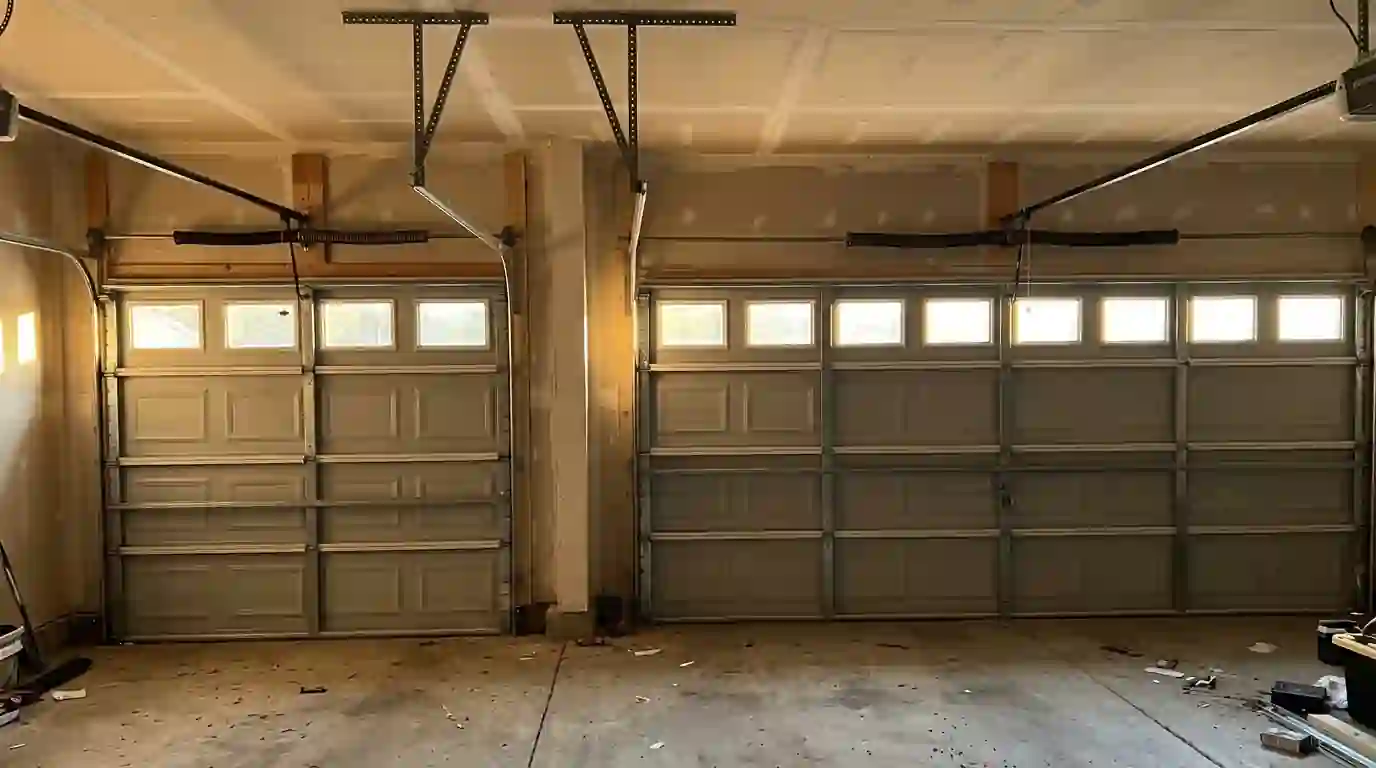
Look above the top of the door. If you see one or two large coils on a steel bar running across the opening, you have torsion springs. They wind and unwind around that bar as the door moves.
If instead you see long springs running alongside the horizontal tracks on each side, stretching toward the back of the garage, you have extension springs. They stretch as the door closes and pull it up as it opens. Many older and lower-ceiling garages use them. Each one should have a safety cable threaded through its center so a broken spring cannot whip across the garage. If yours do not, ask for them when the springs are replaced. Our page on side-mounted spring repair covers that system in detail.
Knowing which type you have helps when you call, because the parts and the job are different.
Should you replace one spring or both?
On a door with two torsion springs, we recommend replacing both even when only one broke. They were installed together and have run the same number of cycles, so the second one is usually close behind. Replacing them together also keeps the door balanced, because a new spring paired with a tired one pulls unevenly.
The same logic applies to extension springs, which come in pairs, one per side. A door with a single torsion spring is a different case. Many builder-grade doors leave the factory with one spring carrying the whole door. When it breaks, the door is completely dead. Converting to two springs during the replacement spreads the load and means a future break does not drop the full weight at once.
How long should a garage door spring last?
Spring life is measured in cycles, and one cycle is one full open and one full close. Clopay's residential door specification rates its standard torsion spring at 10,000 cycles and its optional high-cycle spring at 20,000. This Old House notes that 10,000 cycles works out to about 14 years at one cycle a day.
Most garages run more than one cycle a day. Count the trips: out to work, back home, a run to the store, the kids leaving for school. A garage used as the front door can hit four or five cycles a day, which brings a standard spring down to roughly five to seven years. If that sounds like your house, a high-cycle spring is worth asking about.
Weather plays a part too. Lows reach freezing on about 46 days a year in Tuscaloosa, according to Wikipedia's climate data, and a worn spring is least forgiving on the first open of a cold morning. That is why so many spring calls come in early on winter days.
What does a garage door spring replacement cost?
Published ranges give you a fair idea before anyone looks at your door:
| Job | Published range | Source |
|---|---|---|
| Both torsion springs | $150 to $350 | HomeGuide |
| One torsion spring | $75 to $150 | HomeAdvisor |
| Both extension springs | $120 to $200 | HomeGuide |
| Spring replacement, Birmingham AL (2022) | $200 to $330 | HomeBlue |
The final figure depends on the spring size your door needs, whether the cables and drums survived the break, and whether you choose standard or high-cycle springs. A spring that snaps often frays a cable on the way, and a cable replacement at the same visit is cheaper than a second trip. For the full picture across other repairs, see our Tuscaloosa repair cost guide.
What happens when the new spring goes on?
We clamp the door so it cannot move, measure the old spring's wire size, inside diameter and length, and check those against the door's weight and height. The old spring is unwound under control and the new one is fitted and wound to the right number of turns. Then we balance the door so it holds steady halfway up by hand, check both cables on their drums, and test the opener's force setting and auto-reverse. You hear the price before any of that starts, so read the broken spring repair page if you want the detail first.
Common questions
More questions on this
Not safely through the garage door. Lifting it by hand or forcing it with the opener can drop the door or bend it. Call and we will talk through the safest option.
A wound spring is under tension all the time. Metal fatigue from years of cycles finally gives way at rest, which is why many breaks happen with the door closed.
It can if the opener keeps trying to lift the door. The motor and drive gear take strain they were never built for. Unplug the opener until the spring is replaced.
Often three to five. Count each departure and return. At four cycles a day, a 10,000-cycle spring lasts roughly seven years, about half the one-a-day estimate.
No. Torsion springs sit on a steel bar that contains them when they break. Safety cables belong inside extension springs, which can whip loose without them.
Keep reading
Related articles and services
What Garage Door Repairs Cost in Tuscaloosa, AL
Sourced ranges for springs, cables, rollers, openers and full door replacement.
Read itGarage Door Will Not Close? Check These Five Things
Five checks to run when the door refuses to close or bounces back up.
Read itRepair or Replace Your Garage Door? How to Decide
When a spring job on an old door is the moment to price a new one.
Read it