Garage door blog · Tuscaloosa, AL
Garage door will not close? Five checks for Tuscaloosa homeowners
Door goes down a foot, then bounces back up? Most of the time the cause is one of five things, and three of them you can check in a few minutes with no tools. Here they are in the order we would check them.
- Answered 24/7
- Tuscaloosa and West Alabama
- Three checks need no tools
By Lloyd Yeager, Garage Door Blog EditorUpdated October 2026
A garage door that will not close is most often blocked by its photo eye sensors, the two small boxes about six inches above the floor on each side. Check that both lights are steady, wipe the lenses and clear anything in the beam. If that fails, look for an obstruction, a binding roller, a locked wall control or a weak remote.
Check 1: Are the photo eye sensors blocked or misaligned?
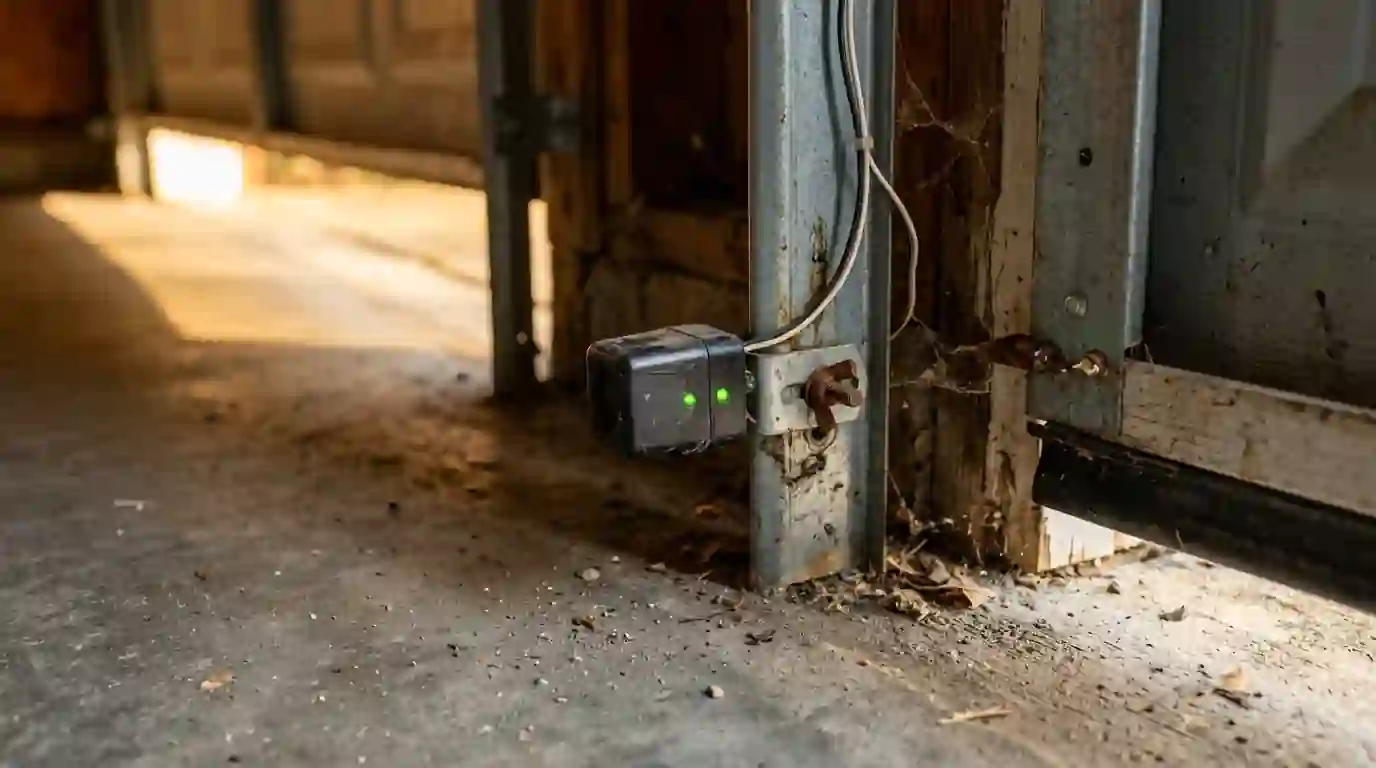
Since 1993, openers sold in the US must reverse when something breaks the invisible beam across the bottom of the door. That beam runs between two small sensors mounted on the tracks, about six inches off the floor. When the opener cannot see a clean beam, it refuses to close, or it starts down and reverses.
Look at the small lights on each sensor. On most LiftMaster, Chamberlain and Craftsman openers, one sensor shows a steady amber light and the other a steady green. A green light that blinks or stays off usually means the two are not lined up. Genie and other brands use different colors, but the rule is the same: steady is good, blinking or dark is a problem.
Try these in order:
- Wipe both lenses with a soft cloth. Dust, pollen and spider webs are common culprits.
- Clear the beam path of trash cans, bikes, boxes and leaves.
- If a sensor has been bumped, loosen its wing nut, point it at the other sensor until the light goes steady, and tighten it again.
- Look along the wire to each sensor for a staple pinched through it or a chewed section.
Late afternoon sun can also blind a sensor that faces west, so a door that will only misbehave at a certain hour points to glare. If the lights still blink after all that, the fault is likely in the sensor or its wiring, which is a job for garage door sensor repair. HomeAdvisor puts sensor realignment at $150 to $250, and HomeGuide puts replacing a faulty sensor at $125 to $300.
Check 2: Is something touching the door on the way down?
Openers also reverse when the door meets resistance, separate from the sensors. Anything the door brushes on the way down can trigger it: a rake leaning on the track, a storage shelf hanging into the opening, a loose weather strip catching on the frame, or a car parked a few inches too far back.
Walk the full height of both tracks and look along the bottom of the door. Then look at the floor itself. A threshold seal that has curled, ice on a cold morning, or a pile of leaves blown against the door will all make it meet the ground early and reverse.
Door stuck open and you cannot get it down? Call any hour and we will talk you through it.
Call (205) 679-9076Check 3: Have the close limit or force settings drifted?
Every opener has a close limit, which tells it where the floor is, and a force setting, which tells it how hard to push before deciding something is in the way. If the door touches the floor and immediately goes back up, the close limit is usually set slightly too far down. The door hits the ground, the opener reads that as an obstruction, and it reverses.
Newer openers set these with buttons on the motor head; older ones use small adjustment screws. Your owner's manual, or the model number on the motor label, will show the method. Adjust the close limit in small steps and test after each one.
Be careful with force. Turning force up to make a stubborn door close is the wrong fix, because it disables the very safety feature that keeps a door from crushing whatever is underneath. A door that needs extra force to close has a problem with its springs, rollers or track. Once you change any setting, run the safety test: lay a 2x4 flat on the floor under the door and close it. The door should reverse within a couple of seconds of touching the board. If it does not, stop using the opener until it is fixed.
Check 4: Is a roller binding or the track bent?
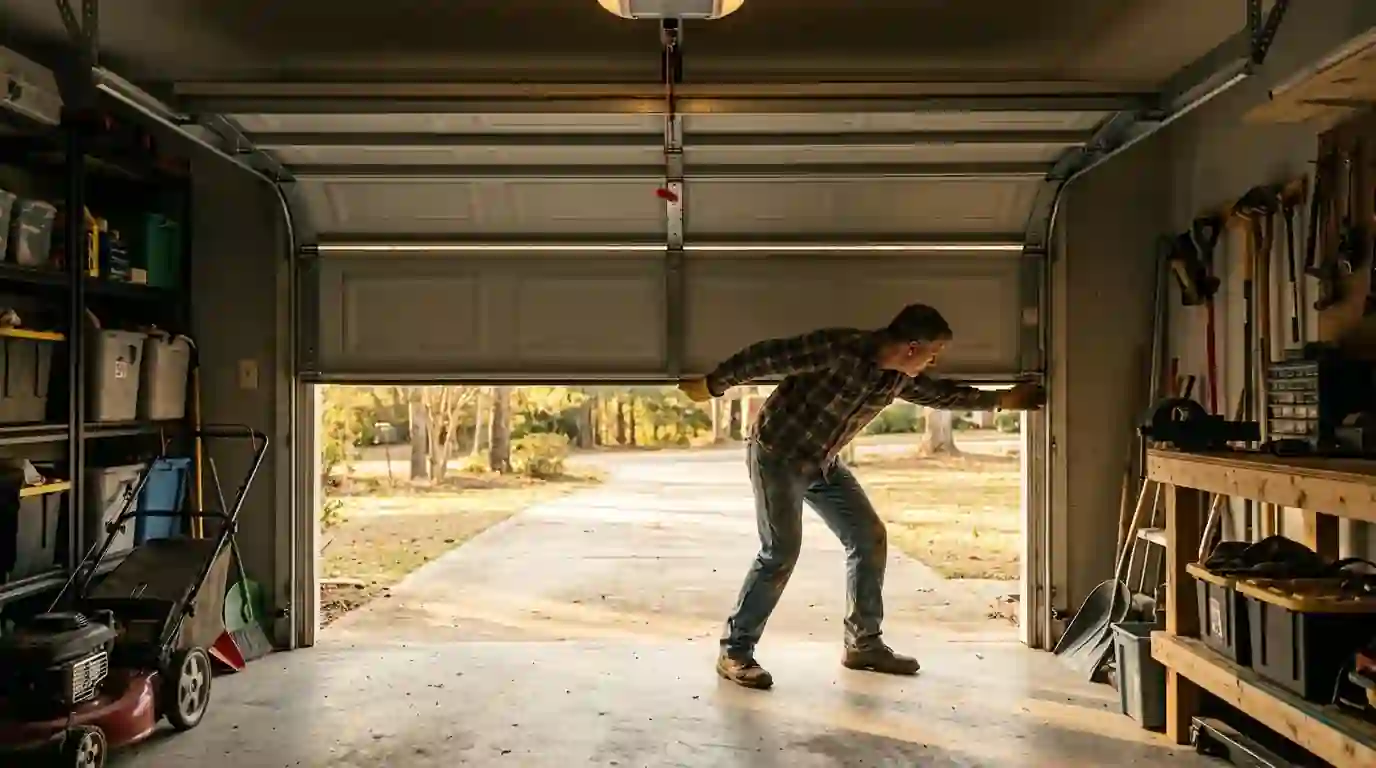
With the door closed, pull the red emergency release cord to disconnect the opener, then lift the door by hand to about waist height and let go. A balanced door stays roughly where you leave it. Now move it up and down slowly. If it sticks in one spot, grinds, or one side lags the other, the fault is in the door rather than the opener.
Look for a roller that has popped out of its track, a track that is bent inward where something hit it, or a bracket pulled away from the wall. Do not try to force a roller back in or hammer a bent track straight while the door is under spring tension. Our track realignment page explains why, and HomeGuide puts realignment of an off-track door at $200 to $350.
Important: only pull the release with the door closed. If the door is stuck open and a spring is broken, pulling the cord can drop it.
Check 5: Is the wall control locked or the remote fading?
Many wall controls have a lock or vacation button. With it on, the remotes stop working but the wall button still runs the door. If the wall button works and the remotes do nothing, look for a lock light on the wall control or the motor head.
If one remote fails and another works, change its battery first. If all remotes stopped together, and especially after a power cut or a move into a new house, they may need to be reprogrammed to the opener. Our remote programming in Tuscaloosa page covers that. It comes up often after a move, and Tuscaloosa sees plenty of them: Census Reporter, using American Community Survey data, shows 31.3 percent of residents moved in during the previous year.
One more trick if the door stalls only when using the remote or wall button: hold the wall button down for the whole close. On most openers that overrides a sensor fault and brings the door down. It is a stopgap, not a fix.
When should you stop and call for help?
Stop troubleshooting and call if any of these are true:
- You heard a loud bang, or you can see a gap in the spring above the door. Read our broken spring guide first.
- A cable is hanging loose or the door sits crooked in the opening.
- The door fails the 2x4 reverse test.
- The opener hums, clicks or grinds with no movement.
- The door is stuck open at night and you cannot secure the house.
In those cases the problem is mechanical, and running the opener again can make it worse. Tell us what you already checked and what the sensor lights are doing. That narrows the visit down to opener repair, the sensors or the door itself, and you hear the price before work starts.
Common questions
More questions on this
Holding the button overrides a sensor fault on most openers. That points to blocked, dirty or misaligned photo eyes rather than a problem with the door itself.
Low sun shining straight into a sensor can blind it. Shading the receiving sensor or swapping the two sides often fixes a door that misbehaves at one time of day.
No. Raising force weakens the reverse protection. A door that needs more force has a spring, roller or track problem that should be fixed instead.
Usually the sensors are out of line, a lens is dirty or something is in the beam. If cleaning and aiming do not steady it, the wiring or sensor may be bad.
Yes. A frozen or stiff bottom seal can meet the floor early and trigger a reverse, and cold thickens grease so the door drags. It usually clears as the garage warms.
Keep reading
Related articles and services
Broken Garage Door Spring: What to Do First
How to recognize a snapped spring and what to leave alone.
Read itWhat Garage Door Repairs Cost in Tuscaloosa, AL
Published ranges for sensors, rollers, openers and other common repairs.
Read itRepair or Replace Your Garage Door? How to Decide
When repeated faults on an old door mean it is time to price a new one.
Read it