Garage door blog · Tuscaloosa, AL
What to check on your garage door once a Tuscaloosa storm has passed
The wind has dropped and the garage door looks wrong? Start inside with the opener switched off. This guide walks through what to look at, what to leave alone, and what to photograph before anything gets moved or fixed.
- Answered 24/7
- Tuscaloosa and West Alabama
- A safe post-storm checklist
By Lloyd Yeager, Garage Door Blog EditorUpdated October 2026
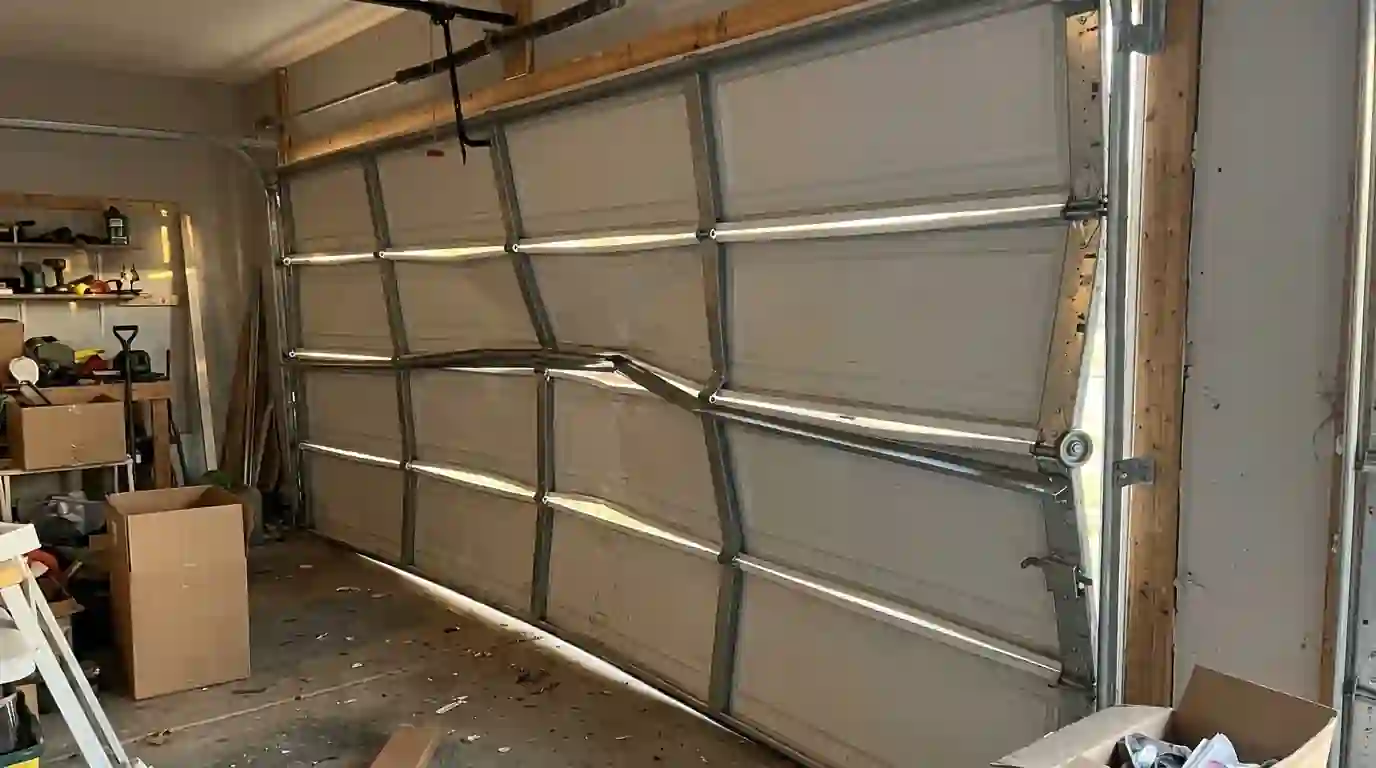
After a storm in Tuscaloosa, look at the garage door from inside with the opener unplugged before you press any button. Check for bowed sections, rollers out of the track, a gap in the spring, slack cables and holes in the panels. If you see any of those, leave the door where it is, take photos and call.
When are Tuscaloosa garage doors most at risk from storms?
Alabama gets two severe-weather seasons, not one. According to Alabama EMA, the main season runs March through May, and a second runs from early November to mid-December. Those are the months when a loose track bolt or a tired strut is most likely to be tested.
Tuscaloosa has lived through the worst of it. The National Weather Service rated the April 27, 2011 tornado EF-4, with estimated peak winds of 190 mph along an 80.68-mile path that crossed Alberta City and Holt. On December 16, 2000 an F4 tornado tracked 18 miles through Tuscaloosa County and hit Hillcrest Meadows, as NWS Birmingham records.
You do not need a storm that size to lose a garage door. On March 17, 2021 an EF-1 with 100 mph winds touched down near East Brookwood, and the same storm produced tornadoes near Moundville and Lake Wildwood, per the NWS. Gusts well short of that can bow a standard door.
What does wind actually do to a closed garage door?
A double garage door is the largest opening in most houses, and wind treats it like a sail. Pressure on the outside pushes the sections inward. On the sheltered side of the house, suction can pull them outward. The struts across the back bend, hinges crack at their pins, and rollers pop out of the vertical track partway up.
Once a door gives way, the problem gets bigger. Wind entering the garage pushes up on the roof and out on the walls from the inside. That is why bracing matters, and why a door that rattled through one storm deserves a proper look before the next one.
A safe post-storm checklist, step by step
Work through this in order. It takes a few minutes and keeps you clear of the parts that can hurt you.
- Stay out if the house is damaged. Downed power lines, a sagging roof or a gas smell come first. Call the utility, not a door company.
- Switch the opener off. Unplug it or turn off the wall control so nobody runs a damaged door by accident.
- Look above the door. A torsion spring with a gap of a few inches in the coil has broken.
- Look at both sides. Check that the lift cables sit tight on their drums and that every roller is inside the track.
- Look at the sections. Sagging in the middle, creased struts or daylight around a panel mean the door was loaded hard.
- Then go outside. Note holes, dents, a split jamb or damaged trim around the opening.
Do not run the opener to test it, and do not pull the red release cord on a door that is stuck open until you know the springs are whole. A door with a broken spring drops with its full weight once it is released.
Found a broken spring, a slack cable or a door out of its track? Leave it where it is and call; the phone is answered 24/7.
Call (205) 679-9076What you can safely do, and what has to wait
Some jobs are fine for a homeowner. You can clear branches and debris away from the outside of the door, sweep water out of the garage, and tape heavy plastic sheeting over a punctured panel from the outside to keep rain out. Keep the car and the kids away from the door until it has been checked.
Leave the rest alone. Springs, lift cables, the bottom brackets that anchor the cables, and the bolts that hold the track to the wall all carry stored force or the door's weight. Forcing a bowed door down with the opener, or hammering a roller back into a bent track, usually turns a repair into a replacement. Our derailed door repair page explains how a door that jumped its track gets realigned, and repair after wind or hail covers the rest of what a storm call involves.
Hail dents: cosmetic, or a reason to replace sections?
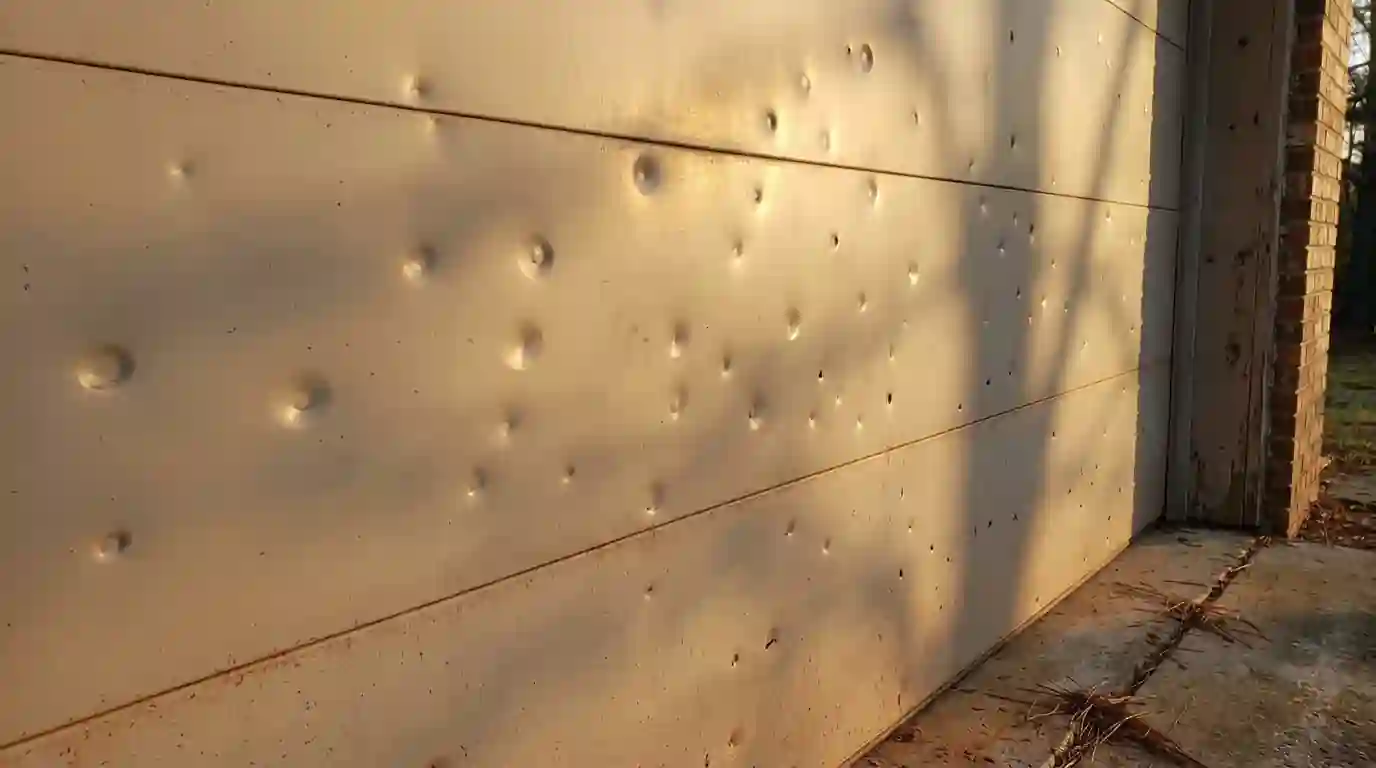
Hail in the Tuscaloosa area tends to peak in March, according to Stormersite, and the most recent report near the city was quarter-size hail on July 21, 2022. Stones that size leave rows of round dents on a steel door, easiest to see in low afternoon light.
Most hail dents are cosmetic. The door still runs, the seals still close, and the main concern is chipped paint that can rust through a humid summer. Thin single-skin steel is the exception: dents along the panel edges can crease the section and affect how it flexes over the top of the track.
If a section does need replacing, HomeGuide puts a single installed panel at $300 to $900, and Angi gives a range of $250 to $1,000. Whether a panel replacement makes sense depends on whether the maker still produces that design, and on how many sections were hit.
Photos and notes that help with an insurance claim
If you plan to file a claim, document the damage before anything is moved, cleaned or repaired. This is general advice; your policy and your adjuster decide what is covered.
- Take a wide shot of the front of the house showing the whole door, then close shots of each dent, hole or crease.
- Photograph the inside too: the springs, both tracks, the struts and any rollers out of place.
- Write down the date and time of the storm and when you first noticed the damage.
- Keep receipts for anything you spend to secure the opening, such as plastic sheeting or a board-up.
- Ask whoever repairs the door for an itemized invoice listing each part replaced.
Bracing or a wind-rated door before the next season?
Two upgrades make a door harder to blow in. A bracing kit adds vertical reinforcement to an existing door, and HomeGuide puts bracing kits at $150 to $500. A wind-rated garage door is built and tested to resist a stated wind load, and HomeGuide lists a single wind-rated door installed at $1,200 to $6,000.
Bracing suits a door that is in good shape. If the storm creased several sections, our guide on whether to repair or replace a garage door walks through the math. And because storms often take the power with them, it is worth reading how to open the garage door in an outage before you need to.
Common questions
More questions on this
Yes. Strong gusts can push the sections inward until struts bend and rollers leave the track. A braced or wind-rated door resists that load far better.
Some play between rollers and track is normal. Loud banging or a door that shifts in its frame points to worn rollers, loose hinges or a door that needs bracing.
Heavy plastic sheeting taped on from the outside keeps rain out. Do not screw plywood into the door sections, since that adds weight the springs are not set for.
They can. Hail often chips the paint at the center of each dent, and bare steel rusts quickly in a humid summer. Touching up the chips slows it down.
Do not try until the springs and rollers are checked. A bowed door can bind in the track halfway up and then drop or twist out of the opening.
Keep reading
Related articles and services
How to Open Your Garage Door in a Power Outage
Storms take the power too. How to use the manual release safely.
Read itRepair or Replace Your Garage Door? How to Decide
When storm damage tips the math toward a new door.
Read itKeeping Rust Off Garage Door Hardware in Humid Summers
Stop hail chips and wet hardware from turning into rust.
Read it