Garage door blog · Tuscaloosa, AL
Choosing a belt, chain or wall-mount opener for a Tuscaloosa garage
Replacing a tired opener, or fitting one to a new door? The drive type decides how loud it is, how much ceiling it takes and what it costs. Here is how chain, belt, screw and wall-mount openers compare, with published price ranges.
- Answered 24/7
- Tuscaloosa and West Alabama
- Four drive types compared
By Lloyd Yeager, Garage Door Blog EditorUpdated October 2026
For most Tuscaloosa garages a belt drive opener is the quiet, all-round choice, a chain drive is the budget workhorse for a detached garage, and a wall-mount opener frees the ceiling for storage or high lift. Angi puts belt units at $160 to $350, chain at $150 to $250 and wall-mount openers at $500 to $750.
What actually differs between the four drive types
Every residential opener does the same job: it moves a trolley or turns a shaft to raise a door that the springs have already balanced. The opener is not lifting the full weight of the door. That is worth knowing, because a strong motor will not fix a door with a broken spring or a binding roller, and a new opener on a badly balanced door wears out early.
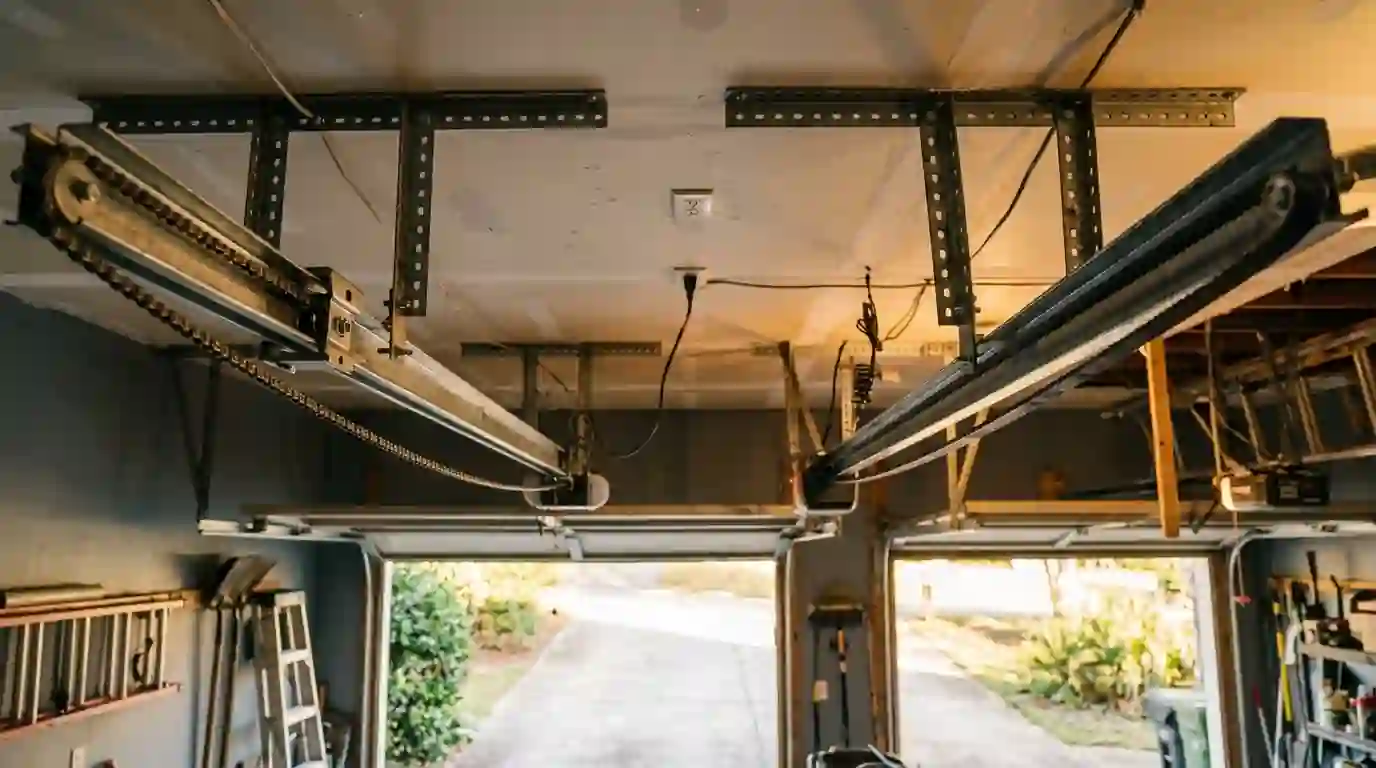
What changes is how the force gets to the door. A chain drive pulls the trolley with a steel chain, like a bicycle. A belt drive uses a reinforced rubber belt instead. A screw drive turns a long threaded rod that moves the trolley. A wall-mount or jackshaft opener skips the rail entirely and bolts to the wall beside the door, turning the torsion shaft directly.
Side by side: noise, space and published prices
The table puts the practical differences in one place. Unit prices are Angi's published ranges for the opener itself, before installation.
| Drive type | Noise | Ceiling space | Unit price (Angi) |
|---|---|---|---|
| Chain | Loudest, metallic rattle | Rail down the center of the ceiling | $150 to $250 |
| Belt | Quiet, smooth | Rail down the center of the ceiling | $160 to $350 |
| Screw | Moderate hum | Rail down the center of the ceiling | $150 to $300 |
| Wall-mount | Quietest in the garage | Ceiling left clear | $500 to $750 |
Installed, the totals move up. Angi puts professional opener installation at $218 to $540, and HomeGuide gives $300 to $900 for the unit and labor together. Wall-mount jobs sit at the top of those ranges because the door has to be suitable first.
Headroom is the other practical check. A rail-mounted opener needs clear space above the door for the rail, the trolley and the curve of the door as it rolls back, and a low-headroom garage or a basement-level garage under a split-level house can leave very little. A wall-mount opener needs almost none above the door, which is often what settles the choice in tight garages.
Not sure which drive suits your door and ceiling? Call any hour and describe the garage; we will tell you what fits.
Call (205) 679-9076Chain drive: strong and cheap, but you will hear it
Chain drives are the oldest design and still the lowest-cost way to motorize a door. They handle heavy wood and double doors without complaint and the parts are simple to service.
The tradeoff is noise and vibration. A chain rattles along the rail and that sound carries through the ceiling joists. In a detached garage or a garage under nothing but attic, that rarely matters. Under a bedroom or a home office, it usually does. Chains also need an occasional tension check, and in a humid garage the links can surface-rust if they run dry.
Belt drive: the usual pick for attached garages
A belt drive does the same work as a chain with a fraction of the noise. That makes it the common choice for attached garages, which is most of the newer housing around Tuscaloosa and Northport. Belts do not rust, need little attention, and run smoothly from the first open to the last.
Belts cost a little more than chains, and on a very heavy door the larger motor sizes are worth having. Battery backup and built-in smart features are common on current belt drive models from LiftMaster, Chamberlain and Genie, which is worth weighing if outages are a concern. Our guide to opening the door in a power outage explains why backup matters here.
Screw drive: fewer parts, more sensitive to heat and cold
A screw drive has the fewest moving parts of the rail-mounted types, and many are fast. The threaded rod needs the right grease to run quietly, and the grease thickens on cold mornings and thins on hot afternoons, which can change how smoothly it travels.
Screw drives have become less common, and finding the same model for a like-for-like swap is not always possible. If you have one that works, keep it lubricated. If it is failing, a belt drive usually replaces it without fuss.
Wall-mount openers: clear ceilings and high-lift doors
A wall-mount jackshaft unit bolts beside the door and drives the torsion shaft. With no rail and no motor hanging in the middle, the ceiling is free for overhead storage racks, a car lift or a high-lift track that raises the door close to the ceiling. Garages with tall ceilings and lake homes with boats and storage racks are where they earn their price.
They are not for every door. A wall-mount opener needs a torsion spring system, not extension springs, and room on the wall at one end of the shaft. A door that is out of balance needs fixing first. Converting from extension springs is possible, and our spring conversion page explains what that involves. Many wall-mount models can also add an automatic deadbolt, and some include a monitor that stops the door if a lift cable goes slack.
Features worth paying for, and when to replace
Whatever the drive, a few features make a difference day to day:
- Battery backup. Runs the door for a limited number of cycles when the power fails.
- Smart connectivity. Phone alerts and remote closing, built in or added later as a smart opener upgrade.
- A soft start and stop. Easier on the door, the rollers and the hinges.
- Motion-sensing lights and a lock mode on the wall control.
- Rolling code remotes. Standard on current openers and a reason by itself to retire one from the 1990s.
HomeAdvisor gives a typical opener lifespan of 10 to 15 years. An opener in that range that needs a logic board or a gear kit is often a candidate for replacement rather than opener repair, especially if the safety sensors or remotes are also dated. Whichever you choose, have the door balanced and the auto-reverse tested when the new opener goes in.
Common questions
More questions on this
In an attached garage, usually yes. The belt is much quieter through the ceiling and needs less attention. In a detached garage the cheaper chain drive is often fine.
No. A wall-mount opener turns the torsion shaft, so the door needs torsion springs. Extension spring doors can be converted first if there is headroom.
It depends on the door's weight and how well it is balanced. A balanced steel double door rarely needs the largest motor; a heavy wood door may.
Usually not. Rails, trolleys and motor heads are matched within a brand and model, so a new opener normally comes with its own rail.
Only partly. A belt drive removes chain noise, but squealing rollers, dry hinges and loose track bolts are door noises a new opener will not fix.
Keep reading
Related articles and services
How to Open Your Garage Door in a Power Outage
Why a battery backup opener matters during outages.
Read itWhat Garage Door Repairs Cost in Tuscaloosa, AL
Published repair and replacement ranges for every common job.
Read itHiring a Garage Door Company: Questions Worth Asking
What to ask before anyone installs a new opener.
Read it